
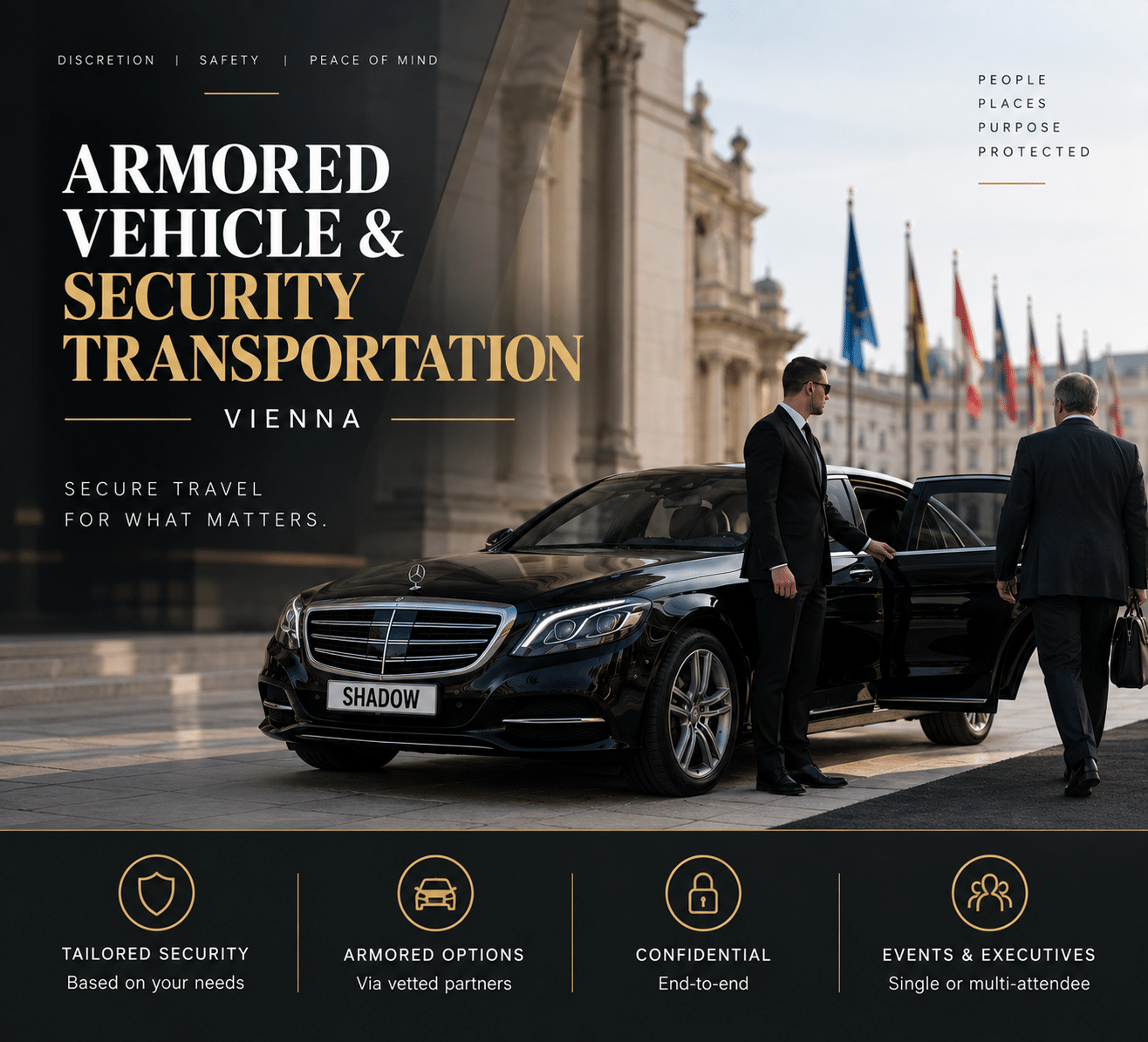
| Quick Facts: Security Transportation | |
| Vehicle range | Standard sedan with security-trained driver, up to armored vehicle via vetted partner |
| Engagement types | Single event, extended stay, multi-attendee coordination |
| Process | Risk assessment first, then vehicle and driver proposal |
| Confidentiality | Shared only with those directly involved in the engagement |
| Booking model | Case-by-case, no standard online booking flow |
Shadow Chauffeur arranges executive protection transportation in Vienna for clients who need a heightened level of security beyond a standard chauffeur booking. This is coordinated through vetted security transport partners. Engagements are arranged individually based on the client’s specific risk profile and itinerary. This service is not offered as a fixed package.
Quick Answer
Security transportation pairs a security-trained driver with an itinerary planned around a client’s specific risk profile. Where needed, an armored vehicle is sourced through a vetted partner. The service is arranged individually rather than sold as a fixed package. It starts with a confidential conversation about the engagement.
Is This the Right Service for You?
This page covers elevated-security transportation, including armored vehicles where a risk assessment warrants it. If you need standard confidential transport for an embassy or diplomatic mission without an elevated security requirement, see the separate diplomatic and embassy transport page, which covers protocol-aware bookings without armored vehicles.
Who Uses This Service
This service is typically arranged for corporate executives during high-visibility visits. High-net-worth individuals requiring discreet, secure movement also use it. Event organizers coordinating secure transport for VIP attendees are another common client. Every engagement is assessed individually. The right vehicle and driver arrangement depends heavily on the specific event, route, and risk profile involved.
Common Engagement Types
Requests typically fall into a few categories. Single-day coverage for a high-visibility corporate visit is one. Ongoing coverage for an executive during an extended stay is another. Coordinated transport for multiple VIP attendees at a single event is a third. Each is scoped differently, and the assessment conversation identifies which category a request falls into.
Vehicle and Driver Options
Vehicle options range from a standard executive sedan with a security-trained driver for a low-profile requirement. At the higher end, an armored vehicle is sourced through a vetted security transport partner for higher-risk engagements. Drivers assigned to these bookings are briefed on the specific security requirements of the engagement before the assignment begins.
Risk Assessment Process
Before any vehicle or driver is assigned, the engagement is assessed. This considers the client’s profile, the route involved, and any known risk factors specific to the visit or event. This assessment determines whether a standard security-trained driver is sufficient. It also determines whether an armored vehicle and additional protocols are warranted.
Route Planning for Higher-Risk Engagements
For engagements involving an elevated risk assessment, route planning includes identifying alternate paths and avoiding predictable, repeated timing where possible. This planning happens before the engagement begins, so the driver already has contingencies in mind rather than reacting in the moment.
Working With Venues and Event Security
For event-based engagements, coordination often extends to the venue’s own security team, confirming drop-off points, timing, and any access requirements ahead of the event itself. This reduces friction on the day, particularly for venues with restricted vehicle access or specific arrival protocols.
Balancing Discretion With Practical Security
A highly visible security presence can sometimes draw more attention than it prevents, depending on the situation. Part of the assessment process considers whether a lower-profile arrangement achieves the client’s goals better than an overtly secured one, rather than defaulting to the most visible option by habit.
Reviewing and Updating Arrangements Over Time
For clients with ongoing engagements, risk profiles and requirements can change. Periodic reassessment ensures the vehicle and driver arrangement still matches the current situation, rather than continuing on an outdated plan simply because it was the original arrangement.
A Simple Way to Start a Conversation
Given the sensitivity of this category of service, the most useful first step is a direct conversation rather than a detailed written request. Sharing the general nature of the engagement, expected dates, and any known constraints allows a proposal to be built around what actually matters for your situation.
How Engagements Are Arranged
Requirements vary significantly by client and event. Engagements begin with a direct conversation to understand the itinerary, risk level, and any specific protocols needed. From there, the appropriate vehicle and driver arrangement is proposed and confirmed before booking. Details of any engagement are handled confidentially. They are shared only with those directly involved in arranging it.
Driver Training and Selection
Drivers assigned to security transportation engagements are selected specifically for this category of work, rather than drawn from the general chauffeur pool. Training and briefing focus on situational awareness, route planning around potential risk points, and coordination with any accompanying security personnel.
International Visitors and Cross-Border Considerations
Clients arriving from abroad for a high-visibility Vienna visit sometimes need security transportation arranged from the airport onward, coordinated with their own protection detail if one is traveling with them. This can be planned in advance as part of the same engagement, rather than arranged separately once the client has landed.
Coordinating With Client Security Teams
For corporate clients with an existing security team, transport arrangements can be coordinated directly with that team. This is preferable to handling transport as a separate, disconnected process. Route planning, timing, and protocol requirements stay consistent with the client’s own security procedures this way.
Event vs. Ongoing Protection
| Factor | Single Event Coverage | Ongoing Protection |
|---|---|---|
| Typical duration | One day or event | Extended stay or recurring need |
| Planning lead time | Days to weeks | Ongoing coordination |
| Vehicle assignment | Confirmed per engagement | Can be kept consistent where practical |
Balancing Discretion With Practical Security Needs
A heavily conspicuous security setup can sometimes draw more attention than it prevents, particularly for clients who prefer to maintain a lower public profile. Part of the assessment process involves finding the right balance between visible security measures and genuine discretion, based on what actually suits the client’s situation.
Vetting and Selection of Partner Providers
Security transport partners are selected based on their track record and specific capability for the type of engagement required, rather than defaulting to a single fixed relationship regardless of the situation. This allows the right partner to be matched to each engagement’s specific risk level and vehicle requirements.
Coordinating Around Public Events
For clients attending a public event, such as a conference keynote or public appearance, timing coordination matters as much as the vehicle itself. Arrival and departure can be planned to minimize time spent in exposed areas such as building entrances, based on the specific venue and event schedule.
Debriefing and Post-Engagement Review
For clients with recurring security transportation needs, a brief review after each engagement can help refine future arrangements, covering anything from route preferences to timing adjustments. This is offered on request rather than imposed as a standard step, since some clients prefer minimal follow-up contact once an engagement concludes.
Why an Individualized Approach Matters
A one-size-fits-all security package rarely fits the actual situation. A low-profile executive visit needs a different setup than a high-visibility public event with multiple attendees. Treating each engagement individually, starting from an honest risk assessment, produces a more appropriate and more defensible arrangement than defaulting to a standard tier.
Confidentiality Practices in Detail
Engagement details are shared only with the driver and coordinator directly involved in delivering the booking. Itinerary information is not retained beyond what is needed for the engagement itself. Requests can specify additional confidentiality measures where the situation calls for them.
Event Organizers and Multi-Attendee Coordination
For events involving several VIP attendees, transport can be coordinated as a single program rather than separate individual bookings. This keeps arrival and departure timing aligned across attendees, which matters for events with a fixed schedule such as a conference opening or an awards ceremony.
Insurance and Liability Considerations
Security transportation engagements, particularly those involving an armored vehicle sourced through a partner, carry their own insurance and liability arrangements distinct from a standard chauffeur booking. These details are confirmed as part of the engagement setup rather than left implicit.
How to Request This Service
Requests should be made directly. Share as much detail as can reasonably be provided about the engagement, timing, and any specific security requirements. Given the individualized nature of this service, requests are reviewed and confirmed on a case-by-case basis. There is no standard online booking flow for this service.
Need secure transportation for an executive, VIP guest, or event in Vienna? Shadow Chauffeur can arrange a confidential consultation to assess your requirements.
Security transportation request page
Frequently Asked Questions
Does Shadow Chauffeur own armored vehicles directly?
Armored vehicles are sourced through vetted security transport partners as needed for a specific engagement. They are not held as a standing in-house fleet.
How much notice is needed for a security transportation booking?
Given the individualized planning involved, as much advance notice as possible is recommended, though urgent requests can be discussed directly.
Is engagement information kept confidential?
Yes, details of any security transportation engagement are shared only with those directly involved in arranging and delivering it.
What types of clients typically request this service?
Corporate executives during high-visibility visits are common clients. High-net-worth individuals and event organizers coordinating secure transport for VIP attendees also use this service regularly.
Can this be coordinated with our own security team?
Yes, transport arrangements can be coordinated directly with an existing corporate security team to keep protocols consistent.
Is ongoing protection available for an extended stay?
Yes, ongoing coverage can be arranged for executives or clients requiring protection across an extended visit, alongside single-event coverage.
Conclusion
Security transportation is arranged individually rather than sold as a fixed package. The right vehicle and driver setup depends entirely on the client’s risk profile and itinerary. A direct, confidential conversation is the starting point for any engagement.