
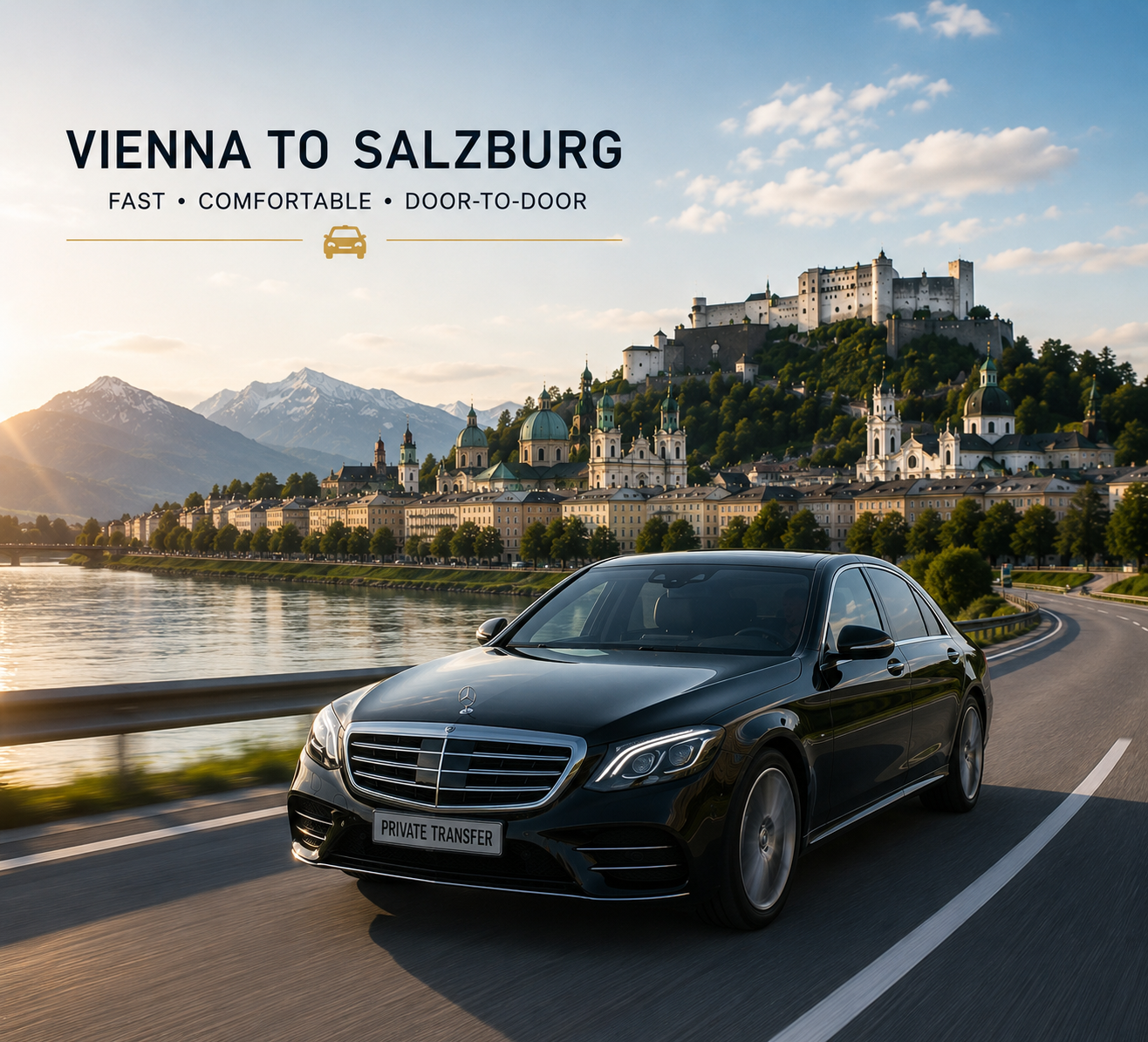
If speed is the priority, the choice between Vienna and Salzburg comes down to two realistic options. You can take the Railjet train or book a direct private transfer by road. Both cover the roughly 295 kilometers in a similar window. This guide breaks down the actual timing. It covers what can slow each option down and how to plan for the fastest possible journey.
Quick Answer
The Railjet train is generally the fastest fixed option, covering the route in around two and a half hours. A direct private transfer by car takes a similar two and a half to three hours on the A1 West Autobahn. The exact time depends on traffic and departure point. Buses are the slowest common option, usually taking three to four hours.
Train: The Fastest Fixed-Schedule Option
The Railjet service between Vienna and Salzburg runs frequently. It covers the distance in roughly two and a half hours under normal conditions. It is difficult to beat on pure point-to-point speed, especially since it avoids road traffic entirely.
The catch is what happens before and after the train ride. Getting to Vienna’s main station takes time. Getting from Salzburg’s station to your final destination adds more. For travelers starting or ending at a hotel outside the city center, this can close the speed gap with a direct private transfer.
Private Transfer: Fast and Door-to-Door
A private transfer by car covers the same distance on the A1 West Autobahn in roughly two and a half to three hours. Unlike the train, this time already includes pickup and drop-off at your actual address. There is no added travel time on either end.
This is different for travelers starting from a hotel or the airport rather than the city center. In that case, a direct private transfer often ends up faster door-to-door than the train, once station transfers are factored in.
Why Door-to-Door Timing Matters
A train’s published journey time only covers the ride itself. It does not include the walk to the platform, the wait for a connecting tram, or the taxi at the other end. A private transfer’s timing already accounts for all of this. The chauffeur meets you at your actual starting point and drops you at your actual destination.
What Can Slow Down Either Option
A few factors affect real-world timing regardless of which option you choose.
Road Traffic
Weekend and holiday traffic near Linz can add time to a road journey. A chauffeur familiar with the route can often anticipate this. They can adjust timing accordingly to avoid the worst of it.
Winter Weather
Snow between December and March can slow driving speeds, particularly in the higher stretches near Salzburg. Trains are generally less affected by weather, though delays are still possible during heavy conditions.
Station Transfers
Time spent getting to and from train stations at both ends of the journey is often left out of journey time comparisons. It can add thirty minutes or more depending on your exact location in either city.
Fastest Option by Starting Point
The fastest choice depends on where your trip actually begins and ends.
| Starting Point | Likely Fastest Option | Why |
|---|---|---|
| Vienna city center to Salzburg city center | Train | No road traffic, direct station-to-station route |
| Vienna hotel outside center to Salzburg hotel | Private transfer | Avoids two separate station transfers |
| Vienna International Airport to Salzburg | Private transfer | Direct pickup with flight tracking, no transfer to the station first |
How to Keep a Private Transfer as Fast as Possible
Book the direct route without stops if speed is the only priority. Detours to Melk Abbey or the Wachau Valley add time by design. Share your flight number for airport pickups so the chauffeur can track delays and adjust timing. Traveling outside weekend peak hours near Linz also helps avoid the traffic that most commonly slows this route down.
How to Keep the Train Journey as Fast as Possible
Choose a hotel close to the station if minimizing total travel time is the goal. Book a direct Railjet service rather than a connection where possible, since a change of trains adds both time and risk of delay. Arrive at the station with enough buffer to avoid rushing, especially during busier travel periods.
Combining Speed With Comfort
Speed is not the only factor worth weighing. A journey that saves fifteen minutes but leaves you cramped or stressed is not always the better choice. A private transfer generally offers more comfort for a similar overall time, particularly once door-to-door pickup is factored into the comparison.
Travelers heading straight into a meeting or event after arrival often value this combination of speed and comfort. It matters more than shaving a few extra minutes off the raw journey time.
Time of Day Considerations
Early morning departures tend to have the least road traffic, which can make a private transfer noticeably faster than a midday or evening trip. Trains are less affected by time of day. Very early or late services may run less frequently, though, so check the timetable before you plan around one.
For airport pickups, arriving during off-peak hours generally means a smoother transfer. Road traffic and airport processing both tend to be lighter outside the busiest arrival windows.
Comparing Total Door-to-Door Time
When comparing options for speed, it helps to measure the full door-to-door time rather than just the advertised journey length. This means including the time to reach the station, the ride itself, and the time from the arrival station to your final destination. Once this full picture is added up, a direct private transfer often comes out closer to the train, or even ahead of it. This is especially true for travelers who are not starting and ending exactly at the two stations.
Speed for Groups vs Solo Travelers
Speed comparisons often assume a single traveler, but the calculation changes for groups. A family checking in luggage for four people at a train station adds real time that a private transfer skips entirely since bags are loaded directly into the vehicle. For solo travelers with a single bag, this difference is much smaller, which is why the train often wins for one person and a private transfer often wins for a group.
Return Journey Timing
If your trip includes a return to Vienna, the fastest way back is usually whichever option you took on the way out. Both the train and a private transfer run in both directions on a similar schedule. Travelers who added scenic stops on the way to Salzburg often prefer a direct return without stops. This is especially true if catching a flight the same evening.
Planning Around a Flight Connection
Travelers connecting from an international flight into a Salzburg meeting or event have the tightest margin for error. A private transfer with flight tracking removes the risk of a missed train caused by a delayed arrival or a slow queue through passport control. This is often the deciding factor for business travelers, even when the raw journey time is similar to the train.
Building in a buffer of thirty to sixty minutes after landing before your requested pickup time helps absorb any unexpected delays at the airport without affecting your overall schedule.
How Shadow Chauffeur Can Help
Shadow Chauffeur runs direct private transfers between Vienna and Salzburg using executive vehicles. The chauffeurs know the A1 corridor well enough to plan around common delays. Pickup can be arranged from a hotel, private address, or Vienna International Airport, with flight tracking included.
Need the fastest possible route without a fixed train schedule to work around? Shadow Chauffeur can arrange a direct transfer timed to your exact departure.
Vienna to Salzburg city-to-city transfer
Frequently Asked Questions
What is the fastest way to get from Vienna to Salzburg?
The Railjet train is generally the fastest fixed option at around two and a half hours. A direct private transfer takes a similar amount of time and can be faster overall once you account for pickup and drop-off at your actual address.
Is driving faster than the train?
Driving time on the A1 West Autobahn is close to the train’s journey time, usually two and a half to three hours. The difference often comes down to your exact starting and ending points rather than the road itself.
Does traffic affect the Vienna to Salzburg drive?
Yes, particularly on weekends and holidays near Linz. A chauffeur familiar with the route can often plan around the busiest periods.
Is the train affected by weather?
Trains are generally less affected by winter weather than road travel, though delays are still possible during heavy snow.
Can I get a fast private transfer directly from the airport?
Yes. A private transfer from Vienna International Airport goes directly to Salzburg without a stop at a train station first, which often makes it the fastest option for air travelers.
Does a connecting train add much time?
It can. A change of trains adds both waiting time and a higher risk of delay compared to a direct Railjet service, so booking a direct train is generally faster when available.
A Simple Way to Decide
If you are still unsure which option is fastest for your specific trip, start by mapping your actual starting point and destination, not just the city names. Add up the realistic time to reach a station if choosing the train, including any connecting transport. Compare that total against a direct private transfer, which already includes pickup at your address. Whichever total is shorter is generally the faster real-world choice, even if it is not the one with the shortest advertised journey time.
Conclusion
For a strict point A to point B comparison, the train and a direct private transfer are close enough in speed that the real deciding factor is your starting point. City center to city center favors the train. Anywhere else, including the airport or an outlying hotel, usually favors a direct private transfer once station transfers are factored in.